
(Pierre, SD) — Carbon pipelines will not be making their way through South Dakota, at least not when eminent domain is needed for a project.
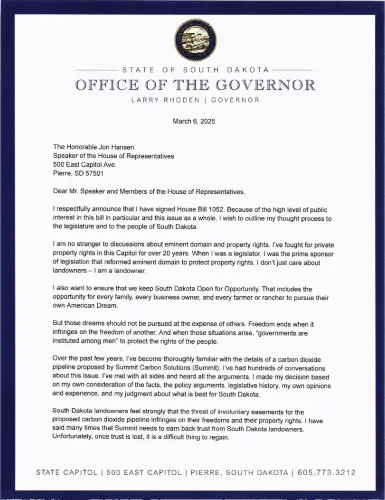
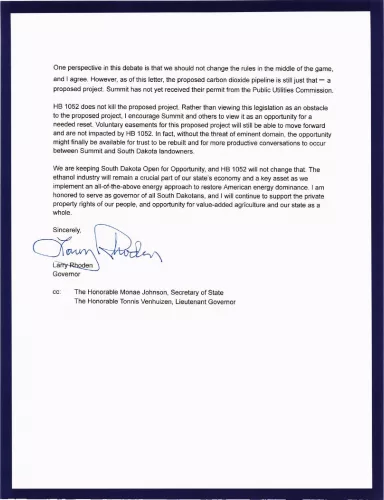
Governor Larry Rhoden signed House Bill 1052 into law yesterday. The law prohibits the use of eminent domain for CO2 pipelines in the state. Rhoden encouraged Summit Carbon to view the law as a reset, saying without eminent domain, it allows the company to rebuild trust with South Dakota landowners. Rhoden also emphasized that House Bill 1052 does not kill a pipeline project proposed by Iowa-based company Summit Carbon Solutions.
HB 1052 was a direct response from pipeline opponents frustrated by the actions of Summit Carbon Solutions. They said Summit employees have conducted land surveys without permission and have used misleading information to get landowners to sign leases allowing Summit’s proposed pipeline to be built across their property. Rhoden said Summit needs to earn back the trust of South Dakotans, which he admits won’t be easy.
Rhoden outlined his reasons for signing the bill in a letter to the legislature and people of South Dakota.
Summit’s proposed pipeline project would connect ethanol companies in Iowa, Minnesota, South Dakota and North Dakota to an underground storage site in southwestern North Dakota.
The American Carbon Alliance (ACA) expressed disappointment over Governor Rhoden’s decision to sign HB 1052 into law, restricting eminent domain for carbon pipelines. “This ill-advised legislation comes at a time when South Dakota farmers and ethanol producers desperately need new markets to restore profitability,” said Tom Buis, CEO of the American Carbon Alliance. “Instead of supporting economic growth, this decision creates unnecessary roadblocks and sends the wrong message to agriculture and rural communities.”
Buis emphasized the lost opportunity for South Dakota to capitalize on growing markets for low-carbon biofuels, including sustainable aviation fuel. “Other states are moving forward, and it’s unfortunate to see South Dakota take a step back,” he said.